
Allegheny County Criminal Court Records
A criminal court record is the court's case file after prosecution begins. In Allegheny County, the Court of Common Pleas Criminal Division handles major criminal prosecutions, while Magisterial District Courts and Pittsburgh Municipal Court handle preliminary arraignments, preliminary hearings, summary matters, and lower-court events. The Department of Court Records Criminal Division is the local file custodian for Common Pleas criminal records and performs the county's criminal Clerk of Courts function.
The record can begin with charges and move through arraignment, pretrial motions, plea or trial, disposition, and sentencing. It can also show probation or parole violation activity, bail entries, restitution, costs, and expungement petitions. For a closer look at the charge list and charge status, use the Allegheny County arrest records and court charges page. The full case outcome belongs in the criminal court record.
The Criminal Division fee source appears in the manifest from the Allegheny County criminal cost and fee schedule.
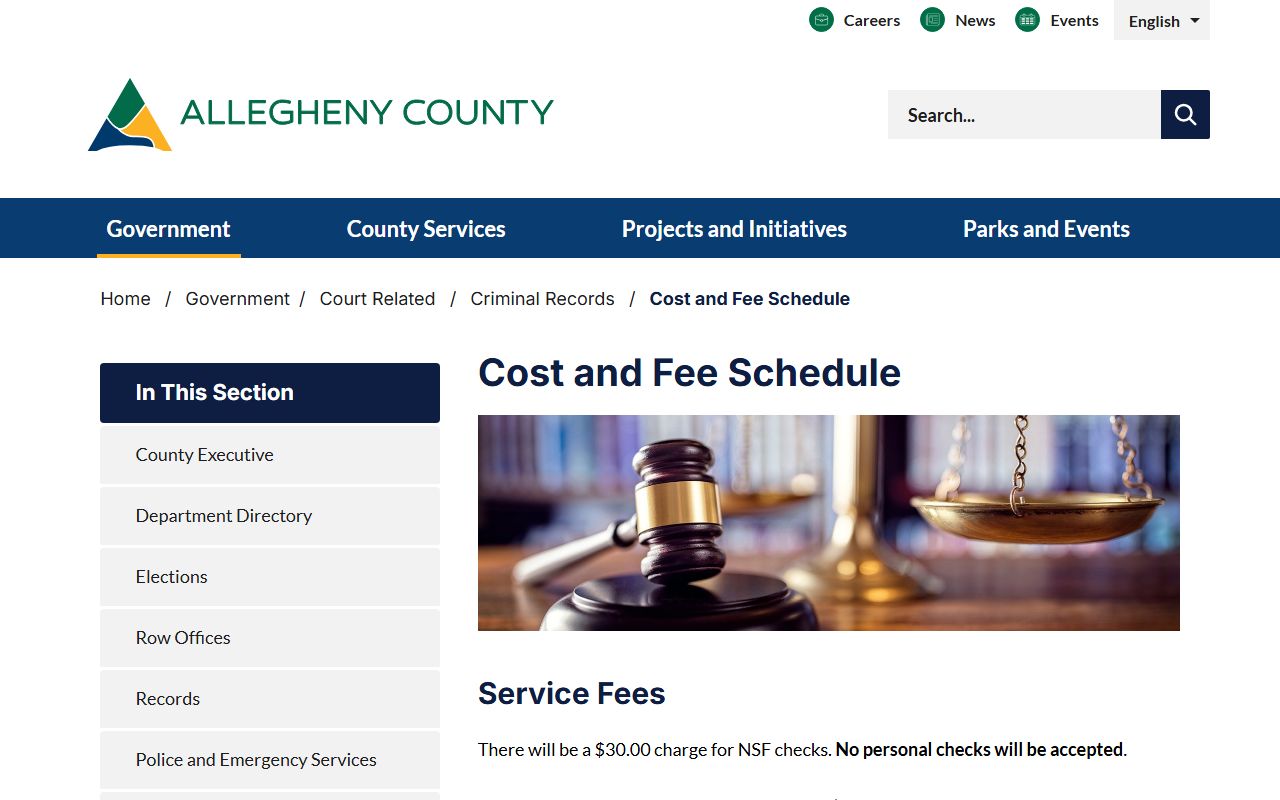
That page is tied to criminal file work because expungement petitions, bail-bond posting, and other criminal filing costs are handled through the court-record process.
Search Allegheny County Criminal Records
Start with UJS Case Search for public criminal docket sheets. UJS can search by docket number, participant name, OTN, police incident or complaint number, and other identifiers. It covers Court of Common Pleas and lower-court docket sheets, so it can show preliminary-hearing records and the Common Pleas docket that follows. The docket sheet can confirm the court, case number, charges, events, disposition, sentence, and financial obligations when those entries are public.
- Search UJS by docket number, defendant name, OTN, complaint number, or state ID number.
- Confirm the county, court type, caption, date, and case status before relying on the record.
- Open the docket sheet and review charges, hearings, pleas, disposition, sentence, and costs.
- Use the DCR Criminal Division for the full file, certified copies, or current and stored criminal records.
- Check whether a sealed, expunged, juvenile, or confidential matter limits public access.
Allegheny County's Criminal Records page says current-year and four prior years criminal files are in Room 220 of the courthouse. Older cases are available but must be ordered from storage. Computer terminals are available for criminal record research, but the county warns that no case-related information will be discussed over the telephone.
Allegheny County Criminal Case Flow
Criminal dockets are easiest to read as a sequence. A case may start in a lower court with a complaint, arraignment, bail issue, or preliminary hearing. If the case proceeds, formal charges move into Common Pleas. The court record then tracks motions, conferences, plea negotiations, trial events, disposition, and sentencing. Not every case has every stage, and some charges may be withdrawn, reduced, dismissed, or resolved separately.
Case flow: Charges Filed › Arraignment › Pretrial / Motions › Plea or Trial › Disposition › Sentencing
| Stage | What Happens |
|---|---|
| Charges Filed | A complaint, information, or other charging document places criminal allegations into the court record. |
| Arraignment | The defendant is advised of the case, rights, bail issues, and next court obligations. |
| Pretrial / Motions | Attorneys file requests, evidence issues are raised, and hearings or conferences are scheduled. |
| Plea or Trial | The case is resolved by plea, bench trial, jury trial, dismissal, or another disposition. |
| Sentencing | The court imposes punishment, probation, restitution, fines, costs, or other conditions when required. |
What Allegheny Criminal Records Show
Allegheny County criminal court records can carry more detail than a public arrest note. A docket may show the OTN, complaint number, arresting agency, charge statute, grade, offense date, bail, plea, disposition, sentence, probation, restitution, and costs. The full file can also include motions, orders, sentencing paperwork, expungement petitions, and other filings maintained by the DCR Criminal Division.
| Field | What It Shows |
|---|---|
| Case Number | The Common Pleas, MDJ, or municipal docket number used to identify the criminal case. |
| Defendant | The person charged in the case, subject to public access and redaction rules. |
| OTN and Complaint Number | Identifiers that connect charges, police complaint data, and court docket entries. |
| Charges | The alleged offenses, statutes, grading, offense dates, and charge status when entered. |
| Plea and Verdict | Whether the defendant pleaded guilty, was found guilty, was acquitted, or had charges otherwise resolved. |
| Disposition | The outcome of each charge or case, including dismissal, withdrawal, guilty finding, or other result. |
| Sentence | Jail, probation, fines, costs, restitution, treatment conditions, or other court-ordered terms. |
Allegheny Charges vs Convictions
A charge is an accusation filed in court. A conviction is a final guilty outcome, usually after a plea or verdict. Allegheny County criminal court records can show charges that never became convictions. Some charges may be reduced, amended, withdrawn, dismissed, or resolved by a problem-solving court path. Reading only the first charge line can misstate the outcome of a case.
| Charge | Conviction | |
|---|---|---|
| Meaning | An allegation filed by law enforcement or prosecution. | A final guilty plea or guilty finding accepted by the court. |
| Where It Appears | Charge list, complaint, information, or docket entries. | Disposition, plea, verdict, sentencing, and final event entries. |
| Can Change | Yes, charges may be amended, reduced, dropped, or dismissed. | The conviction remains unless later changed by appeal, expungement, or other court action. |
Problem-solving courts also affect how some criminal matters move. Allegheny County Criminal Division has DUI Court, Drug Court, Mental Health Court, Veterans Court, Domestic Violence Court, and Sex Offender Court. These programs do not erase the need to read the docket carefully, but they can explain treatment, supervision, or diversion entries.
Read Dispositions and Sentences
The disposition is the outcome of a charge or case. It may show guilty, not guilty, dismissed, withdrawn, nolle prosequi, or another result. A sentence is a separate court action that follows a conviction or qualifying plea. It can include incarceration, probation, restitution, fines, costs, treatment, community supervision, or other conditions. In Allegheny County, PAePay may show approved financial obligations, but a payment screen is not a substitute for the full docket.
Bench warrants can also appear in criminal docket activity when a defendant misses court or violates an order. Common Pleas criminal bench warrants are handled by the Sheriff's Warrant Office, while lower-court warrants may relate to MDJ or Pittsburgh Municipal Court cases. For active warrant limits and the sheriff's in-person instruction, use the warrant page rather than relying only on a docket note.
Allegheny Sealed vs Expunged Records
Sealing and expungement are not the same. A sealed record is hidden from ordinary public view because of a statute, court order, or policy. An expunged record is removed, sealed, or destroyed as allowed by law. Allegheny County's expungement materials say some Probation Without Verdict expungements are automatically filed by Adult Probation after successful completion and payment, but ASI program expungements are not automatic and require a motion with DCR Criminal Division.
| Sealed | Expunged | |
|---|---|---|
| Public Visibility | Hidden from ordinary public access. | Removed or treated as unavailable under the expungement order. |
| How It Happens | By law, court rule, policy, or sealing order. | By eligibility and court action under Pennsylvania law, such as 18 Pa.C.S. § 9122. |
| Allegheny Practice | Sealed cases do not appear like ordinary public dockets. | Some PWV matters may be filed automatically; ASI matters require a motion. |
The manifest includes the county expungement overview.
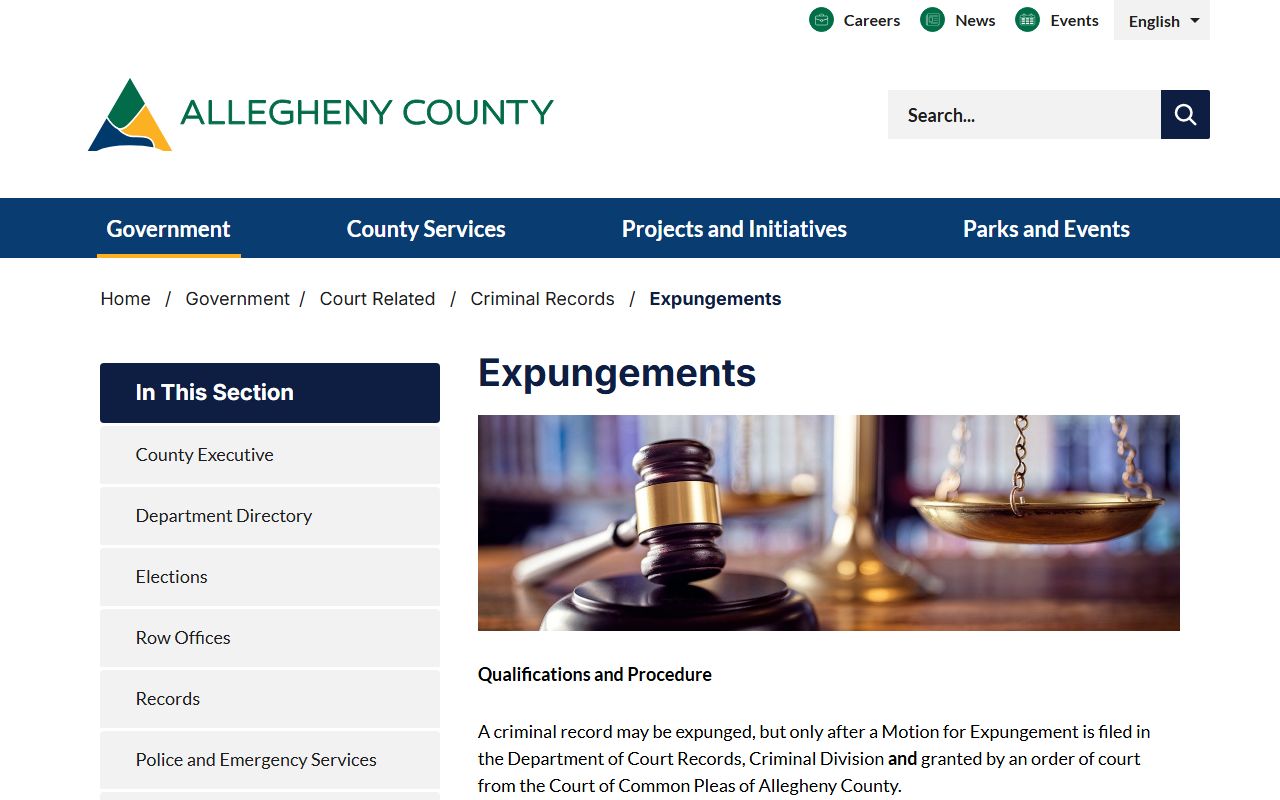
That county page is central because it separates automatic PWV handling from ASI cases that require a filing.
The manifest also captures the county expungement procedure.
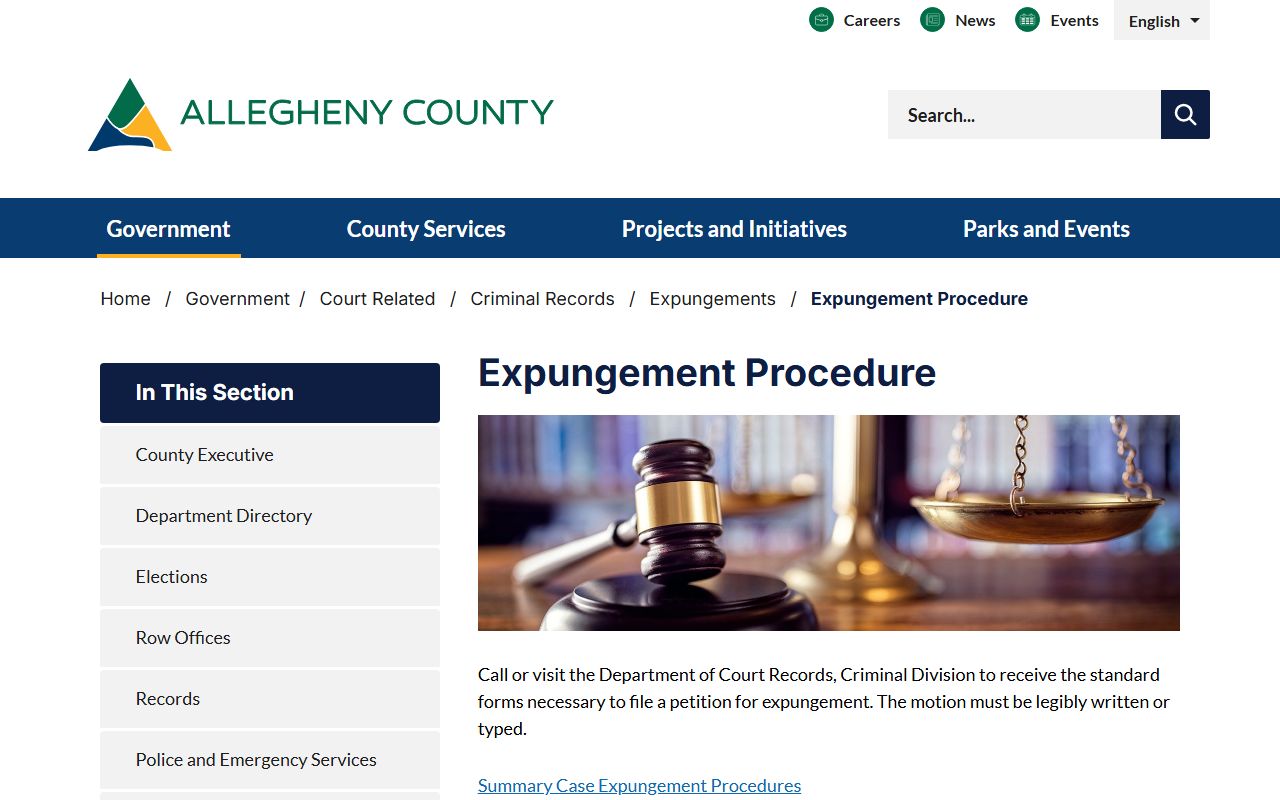
The procedure source confirms that forms come from the DCR Criminal Division and that staff do not give legal advice.
Public Access to Allegheny Criminal Records
Public criminal case records are governed by the Pennsylvania Case Records Public Access Policy and local court custody rules. Allegheny County says Common Pleas case files are open unless sealed by court order and that requesters should not use the county Open Records Fill-In Form for those case files. The proper custodian is the court office or DCR division that maintains the case file.
Key Rules:
Case Records Public Access Policy sets statewide access and confidential-information rules for court case records.
Pennsylvania Right-to-Know Law governs agency records, while court case records use court policy and custodians.
Restricted Allegheny Criminal Records
Juvenile matters, sealed cases, expunged records, mental-health information, abuse-victim information, and confidential identifiers may be withheld from public criminal record searches. The UJS policy also requires confidential information handling in paper and electronic case records. If a docket cannot be found, that does not prove no case ever existed. The file may be restricted, sealed, expunged, stored, misidentified, or held at a different court level.
The Allegheny County Office of the Public Defender provides representation for people who cannot afford counsel in proceedings where representation is constitutionally required. The District Attorney files and prosecutes criminal cases. Those offices are part of the case process, but DCR remains the record custodian for criminal court files.