
Allegheny County Arrest Records and Court Charges
Allegheny County arrest records start with the arrest or custody event. Official county research did not locate a direct public jail-roster search form on the reviewed Allegheny County pages. The jail site routes users to inmate information resources, jail reports, phone contact, VINE, PA DOC for state-sentenced inmates, and court dockets for case clues. The Allegheny County Jail is the local custody facility, but a court charge record begins in the judicial system, not on a jail information page.
Charges after arrest are filed and tracked through criminal dockets. The charging side may show a criminal complaint, information, statute, grade, offense date, OTN, complaint number, arresting agency, charge status, plea, disposition, and sentence. The full criminal case record and outcome are covered in Allegheny County criminal court records. The custody side, including VINE and jail contact options, belongs with inmate search channels.
The manifest image from the Allegheny County Public Defender overview connects arrest and charge records to the first practical defense channel.
That source matters because people facing charges may need counsel before acting on a docket or warrant entry.
Find Allegheny County Arrest Records and Charges
Use separate channels for custody facts and filed charges. For charge records, start with UJS Case Search, which can show Common Pleas, Magisterial District Court, and traffic or summary docket sheets. Search by defendant name, docket number, OTN, police incident or complaint number, or state ID number when known. For local criminal files, use the Department of Court Records Criminal Division after the docket is identified.
- Search UJS by name, docket number, OTN, complaint number, or state ID number.
- Confirm that the result is in Allegheny County and check the court level.
- Open the docket and read each charge, statute, grade, and current status.
- Check for amended, withdrawn, dismissed, guilty, not guilty, or sentencing entries before drawing conclusions.
- Use jail, VINE, or PA DOC channels only for custody status, not as proof of a final court outcome.
The county jail phone number is used for jail contact, but the official pages reviewed did not provide a full public booking database. Pennsylvania VINE provides custody and criminal-case notifications. The PA DOC locator is for state-sentenced inmates and parolees and explicitly excludes county-facility inmates.
Allegheny Charges After Arrest
After an arrest, the court record focuses on what is formally filed. Pennsylvania research for Allegheny County identifies criminal complaints, informations, charges, OTN, docket entries, plea entries, verdicts, sentencing orders, probation or parole violation entries, bail information, and expungement petitions as criminal record material. A preliminary hearing in a Magisterial District Court can test whether charges proceed to Common Pleas. Later filings may change the charge list.
| Document | Who Uses It | What It Does |
|---|---|---|
| Complaint | Law enforcement or prosecution | States the initial criminal allegations and can start the lower-court record. |
| Information | District Attorney | Sets out formal charges pursued in Common Pleas after preliminary steps. |
| Indictment | Grand jury process when applicable | Formal accusation used in certain serious or complex criminal matters. |
The District Attorney is Stephen A. Zappala Jr., and the office prosecutes criminal cases in Allegheny County. The Public Defender provides legal counsel to eligible people who cannot afford a lawyer in proceedings where representation is constitutionally required.
The manifest image from the Public Defender leadership and staff page supports the local defense-office context.
The leadership source helps distinguish public defense services from the court office that maintains the actual charge record.
Allegheny County Charge Status
Charge status can change many times between arrest and final case outcome. A docket may list a charge as filed, held for court, amended, reduced, withdrawn, dismissed, nolle prossed, guilty, or not guilty. One arrest can produce several charges, and each charge can have a different outcome. Read the final disposition and sentence entries before treating a filed charge as a conviction.
| Status | What It Means |
|---|---|
| Pending | The charge is open or awaiting the next court action. |
| Amended | The charge text, statute, grade, or count was changed by later filing or court action. |
| Reduced | The charge was changed to a lower grade or lesser offense. |
| Withdrawn or Dismissed | The charge did not continue to conviction in its listed form. |
| Nolle Prosequi | The prosecution declined to proceed on that charge, subject to court practice and docket context. |
| Guilty or Not Guilty | The charge reached a plea, verdict, or court finding. |
Note: Charge status is read count by count, because one case can contain mixed outcomes.
Allegheny Charges vs Convictions
A charge is the accusation. A conviction is a final guilty outcome. Allegheny County arrest records may show that a person was taken into custody, while the court charge record shows what was filed and how each count moved through court. A dismissed or withdrawn charge should not be described as a conviction. A guilty plea or guilty verdict should be read with the sentence entry to understand the court's final action.
| Charge | Conviction | |
|---|---|---|
| Stage | Filed after arrest or investigation. | Entered after plea, verdict, or qualifying court finding. |
| Meaning | An allegation that must still be resolved. | A final guilty outcome on a count. |
| Where To Read | Complaint, information, charge list, OTN, and docket entries. | Disposition, plea, verdict, sentence, and final docket entries. |
Statewide Custody and Charge Tools
Statewide systems can help, but they do not replace Allegheny County court dockets. Pennsylvania VINE is a custody and criminal-case notification service. The Pennsylvania DOC locator is for state-sentenced inmates and parolees, and the research file notes that it excludes county-facility inmates. A person held in Allegheny County Jail may not appear in the PA DOC tool.
The manifest image from the PA DOC inmate and parolee locator supports that distinction.
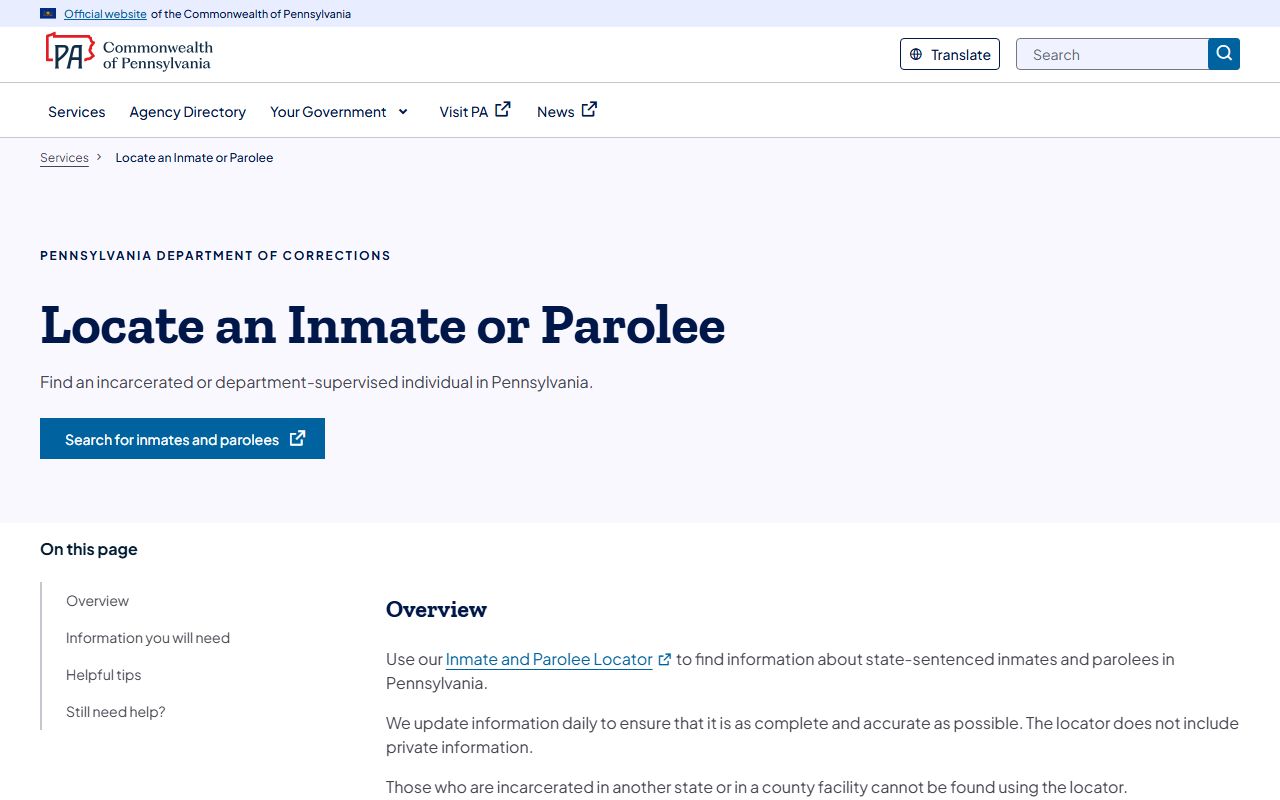
The DOC locator is useful only after a person is in state custody or on state parole, not for ordinary county booking status.
The manifest also includes Pennsylvania VINE.
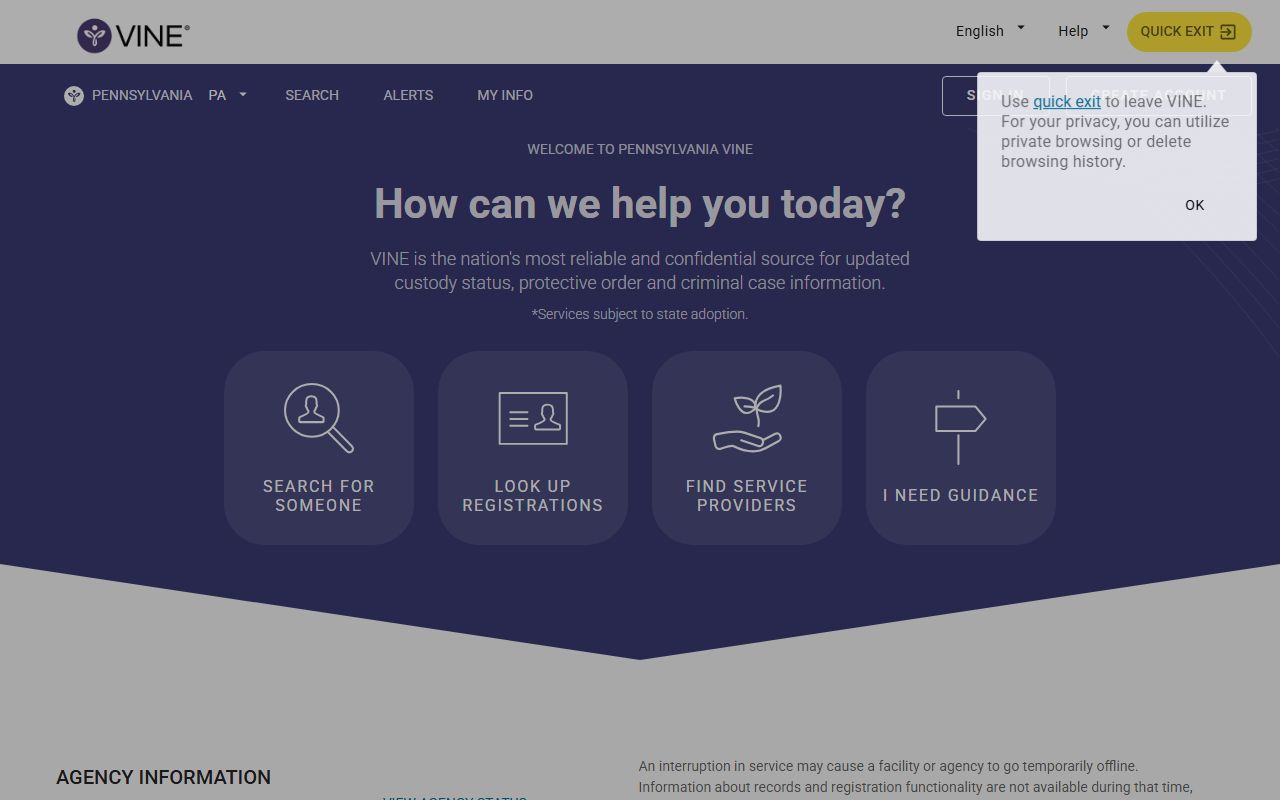
VINE helps with notifications, while the court docket remains the better source for the formal charge record and court outcome.
Sealed and Expunged Charge Records
Sealed, limited-access, and expunged records can affect both arrest records and charge records. Allegheny County's expungement materials say some Probation Without Verdict matters may be filed automatically by Adult Probation after successful completion and payment, but ASI program expungements require the individual to file a motion with DCR Criminal Division. The county also lists a filing fee for expungement petitions in the criminal fee schedule.
| Sealed or Limited Access | Expunged | |
|---|---|---|
| Public Search | Hidden or restricted from ordinary public view. | Removed, sealed, or destroyed as allowed by court order and law. |
| Common Reason | Juvenile, confidential, sensitive, or court-ordered privacy limits. | Eligibility under Pennsylvania criminal-record expungement law. |
| Allegheny Step | Check DCR or court order status when a public result is missing. | Use DCR Criminal Division forms and procedure when filing is required. |
Charge Codes and Severity
Charge records often list a statute, grade, and count number. The statute identifies the law alleged to have been violated. The grade helps show seriousness, such as felony, misdemeanor, or summary offense. The count number separates one charge from another. A single arrest can generate several counts, and each count can have its own status and final disposition.
For Allegheny County, lower-court criminal events may start at a Magisterial District Court or Pittsburgh Municipal Court. Felony and major misdemeanor prosecutions can move into Common Pleas Criminal Division. The docket, court, and charge grade help show where the case is in that path.
Restricted Allegheny Arrest Records
Not every arrest-related or charge-related record is public. Juvenile records are often restricted. Sealed and expunged records are not shown through ordinary public searches. Mental-health information, victim information, child identifiers, and law-enforcement-sensitive information may be withheld or redacted. The Pennsylvania Case Records Public Access Policy governs confidential information in court records, and the Right-to-Know Law has exemptions for agency records such as personal identification and law-enforcement-sensitive material.
A missing public search result should be handled carefully. It may mean no public case exists, but it can also mean the matter is sealed, expunged, juvenile, stored, filed under a different identifier, held at a lower court, or not yet docketed. Use court records for formal charge outcomes, custody tools for custody status, and counsel for legal decisions.