
How to Search Allegheny County Court Records
The broadest starting point for Allegheny County court records is Pennsylvania UJS Case Search. It publishes free public docket sheets for Court of Common Pleas cases, Magisterial District Court cases, and many traffic or summary matters. UJS is useful when the name, docket number, police complaint number, offense tracking number, or state ID number is known. It is a docket system, so it shows case events and selected case data rather than every scanned pleading or certified file copy.
The county also runs the Allegheny County Department of Court Records portal. The DCR portal connects users to civil, family, criminal, marriage, e-filing, and retrieval functions. The DCR civil and family case search is case-ID oriented and asks for a Standard Case ID or Non Standard Case ID plus a CAPTCHA. When a full document, certified copy, or older file is needed, the custodian is usually a DCR division rather than the statewide docket page.
- Search UJS first when the party name, docket number, OTN, complaint number, or court level is known.
- Use the county DCR case search when the civil or family case ID is known or a local retrieval path is needed.
- Match the docket number, caption, court, filing date, and case status before relying on a result.
- Check whether the case belongs to Common Pleas, a Magisterial District Court, or Pittsburgh Municipal Court.
- Request copies from the correct DCR division or court office if the online docket does not provide the needed record.
The county court records page describes the Department of Court Records division structure. That source is useful before choosing an office because Allegheny County uses one DCR brand, while civil/family, criminal, and Wills/Orphans' Court functions are handled by separate divisions.
The DCR search screen is shown in the county manifest from the Department of Court Records case-search page.
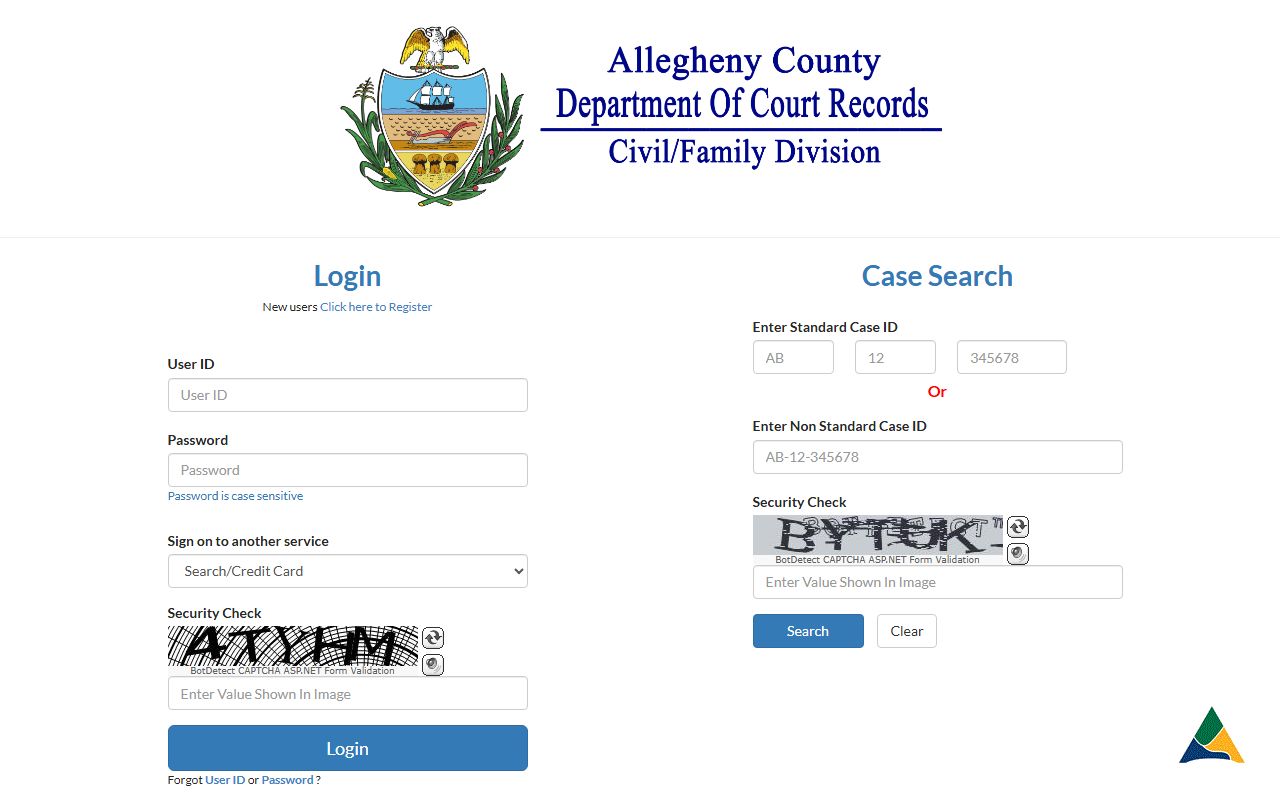
The image matters because Allegheny County's local search is not a broad name-only portal; it is built around case identifiers and a security check.
Allegheny County Court Records Search Fields
UJS and DCR do different jobs. UJS supports public docket discovery across Pennsylvania courts, including Allegheny County Court of Common Pleas and Magisterial District Court matters. PAeDocket, advertised through the UJS portal, also supports mobile docket searches. DCR's civil and family screen is narrower and asks for local case identifiers. A strong search often starts wide in UJS, then moves to DCR or an in-person office once the exact case is confirmed.
| Field Label | Type | Required | Notes / Format |
|---|---|---|---|
| Case Number | Text | Optional if another search is used | Exact docket or case number in UJS or PAeDocket. |
| Participant Name | Text | Optional | Person-name search for civil, criminal, MDJ, and traffic dockets. |
| Organization Name | Text | Optional | Business or agency party search. |
| Offense Tracking Number | Text | Optional | Criminal OTN when known. |
| Police Incident or Complaint Number | Text | Optional | Useful for MDJ, traffic, and criminal records. |
| State ID Number | Text | Optional | Criminal-history identifier if known. |
| Enter Standard Case ID | Text | Unspecified | DCR civil/family search by standard Allegheny case identifier. |
| Security Check | CAPTCHA | Yes | DCR requires the CAPTCHA before submission. |
The statewide portal appears in the manifest from the Pennsylvania Judiciary Web Portal.
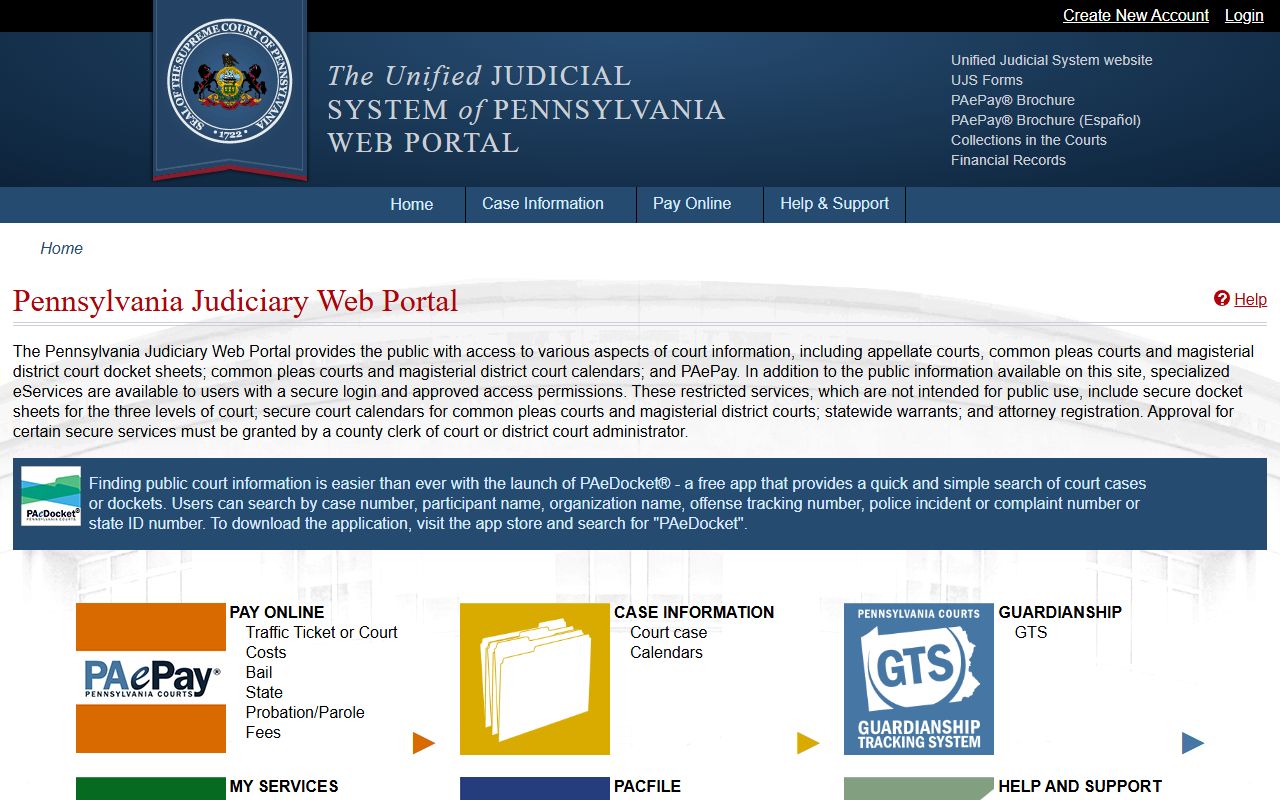
This statewide route is most useful when a case may have moved between Allegheny County lower courts and the Court of Common Pleas.
Types of Allegheny County Court Records
Allegheny County court records reflect the Fifth Judicial District's structure. The Court of Common Pleas has Civil, Criminal, Family, and Orphans' Court divisions. Lower-level records come from Magisterial District Courts throughout the county and Pittsburgh Municipal Court within the city. The file type and custodian matter because a civil judgment, a criminal sentencing entry, a custody order, an estate filing, and a traffic citation can all be public court records, but they are not requested in the same way.
Civil and family filings are maintained through the DCR Civil/Family Division, which performs the former Prothonotary functions. Criminal files are handled by the DCR Criminal Division, the local equivalent of a Clerk of Courts for criminal cases. Wills, estates, adoptions, guardianships, and marriage-related court records sit with the Wills/Orphans' Court Division. Traffic, landlord-tenant, summary, and preliminary-hearing dockets often start in Magisterial District Courts or Pittsburgh Municipal Court.
- Civil records can include complaints, answers, motions, arbitration records, orders, judgments, liens, name changes, and appeals.
- Criminal records can include complaints, informations, charges, pleas, verdicts, sentencing orders, bail entries, and expungement petitions.
- Family records can include divorce, custody, support, paternity, protection from abuse, and related orders, with privacy limits for some details.
- Orphans' Court records can include wills, letters, estates, trusts, guardianships, and audits, while adoption records are confidential.
- Magisterial and municipal records can include traffic citations, summary offenses, landlord-tenant cases, small civil claims, and preliminary hearings.
The manifest image from the Civil and Family Court Records office page anchors the civil and family side of DCR.
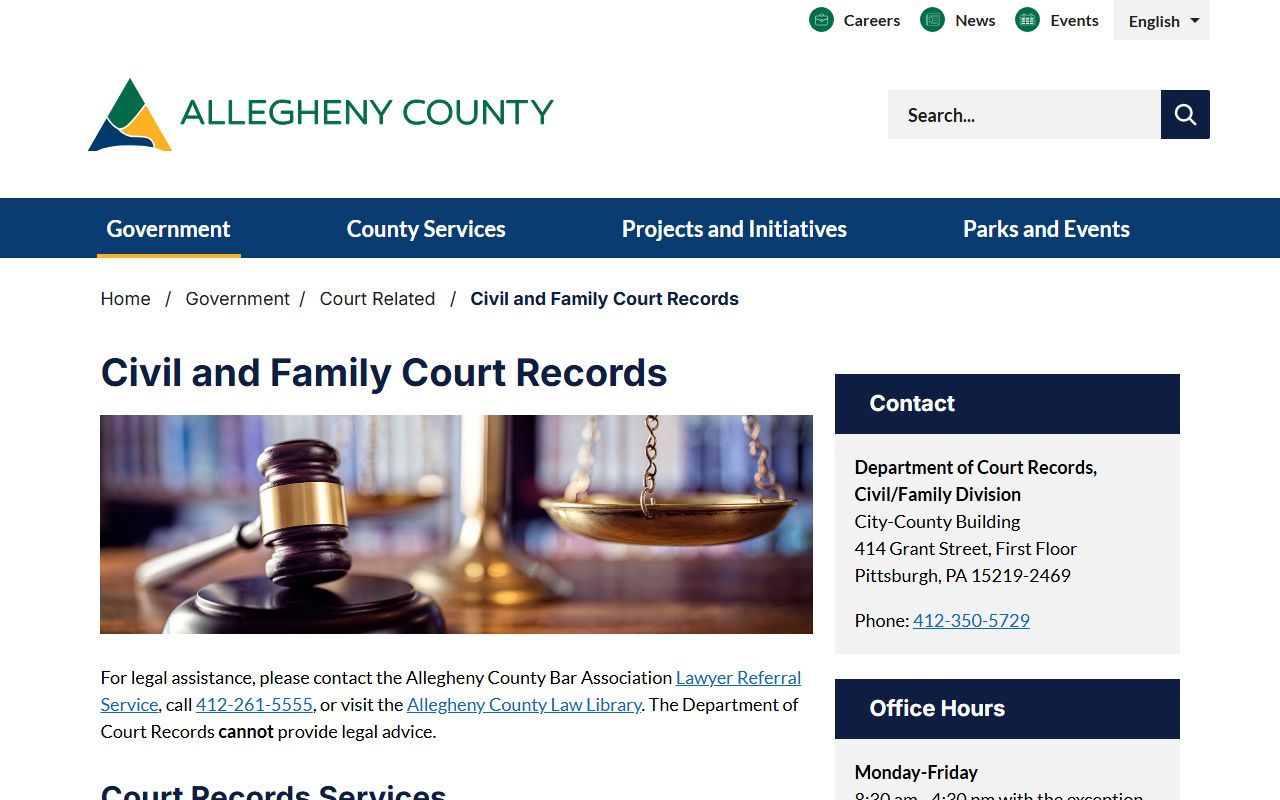
Civil and family records are often the files that need direct DCR contact after a docket or case number is found.
What Allegheny County Court Records Show
A public docket sheet is a map of the case, not always the whole file. It can show the docket number, court, division, case caption, filing date, case status, parties, attorneys, event entries, scheduled proceedings, orders, dispositions, and financial obligations. Criminal and traffic matters may add OTN, complaint number, arresting agency, charges, statute, grade, plea, sentence, restitution, and costs. Civil and family matters show pleadings and orders, but confidential family details may be suppressed.
| Field | What It Shows |
|---|---|
| Docket Number | The official case identifier used by UJS, DCR, or the issuing court. |
| Caption and Parties | The case name and the plaintiff, defendant, petitioner, respondent, or other parties. |
| Court and Division | Whether the matter is Common Pleas, MDJ, Pittsburgh Municipal, Civil, Criminal, Family, or Orphans' Court. |
| Event Log | Chronological entries for filings, orders, hearings, continuances, dispositions, and payments. |
| Criminal Details | OTN, complaint number, charges, statute, grade, plea, disposition, sentence, probation, restitution, and costs when docketed. |
| Civil or Family Details | Case type, motions, judgments, conferences, orders, and restricted family information where public access allows. |
| Financial Entries | Fines, costs, restitution, balances, or payment eligibility when approved for PAePay. |
Allegheny County's criminal file access is represented in the manifest from the Criminal Records office page.
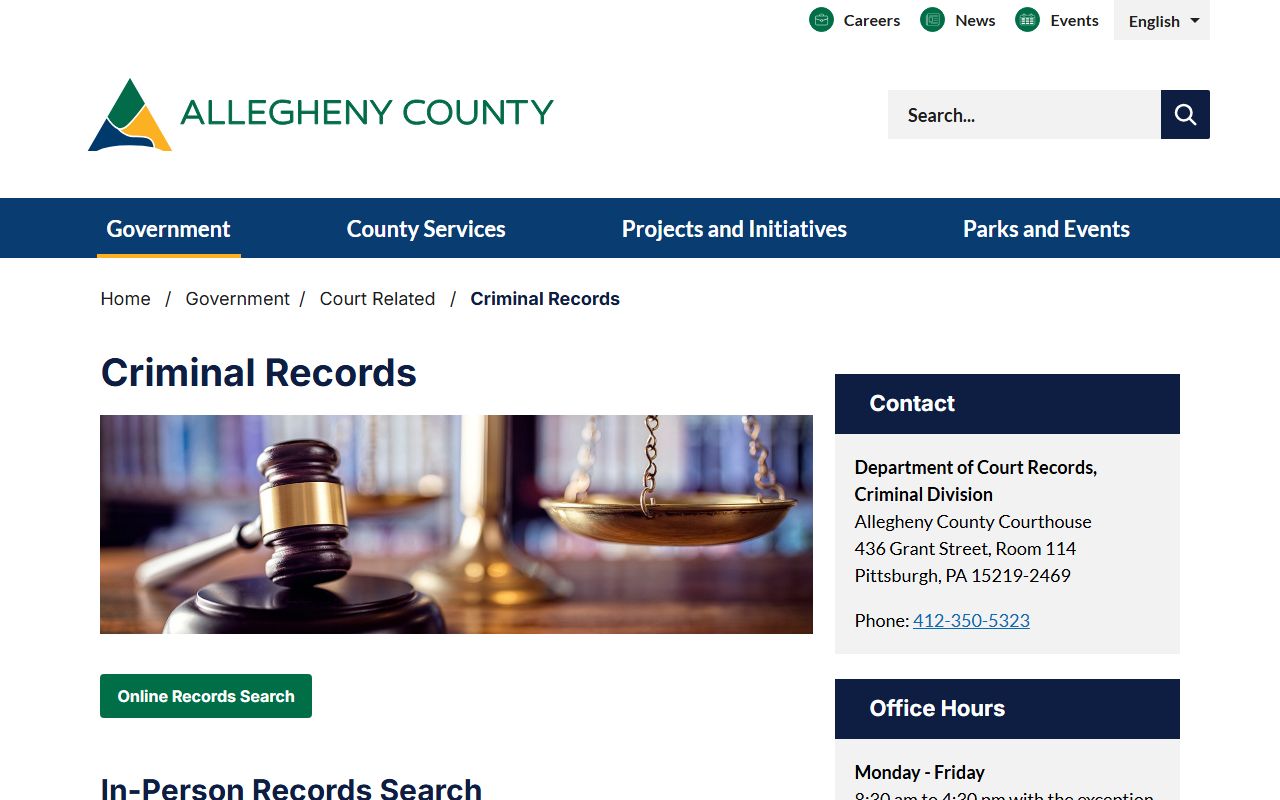
That source is important because current criminal files and older stored files follow different practical access paths.
Public Access for Allegheny County Court Records
Pennsylvania separates court case records from ordinary county agency records. The Allegheny County court-record open-records guidance says Court of Common Pleas case files are open unless sealed and that the Open Records Fill-In Form is not needed for those case files. A requester should use the court custodian, such as the relevant DCR division, before using the county Right-to-Know process.
The statewide access framework comes from Pennsylvania courts public-records policies and the Case Records Public Access Policy. The Pennsylvania Right-to-Know Law applies to agency records, while judicial agencies handle case records under court policy and rules. For non-court county records, the Allegheny County Open Records page lists online, mail, fax, email, and in-person request channels.
Note: A docket can be free online while certified copies or stored files still require DCR contact.
The manifest includes the county guidance from the Court Records Open Records page.
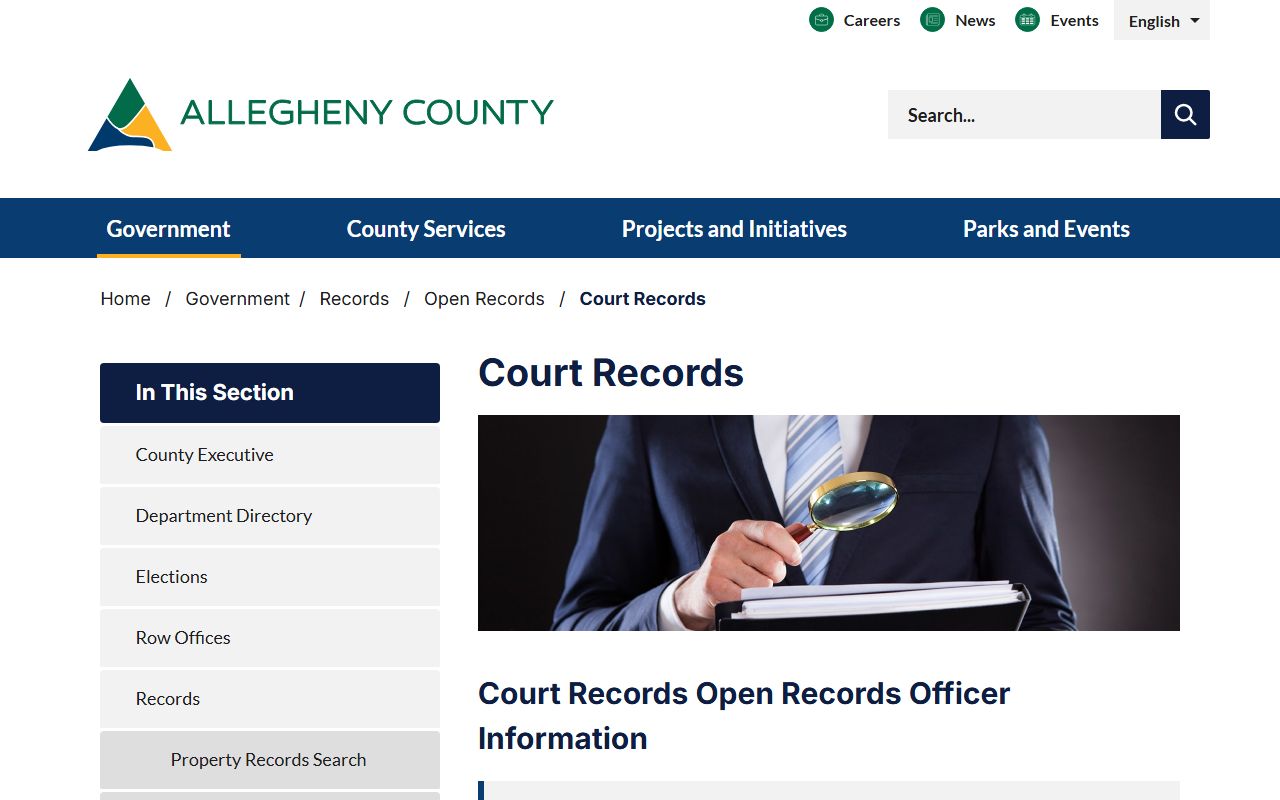
That county instruction prevents a common mistake: sending Common Pleas case-file requests through a general RTK form.
Restricted Allegheny County Court Records
Some Allegheny County court records are public only in part, and some are not public at all. Juvenile matters often have restricted access. Adoption records in Orphans' Court are confidential. Mental-health proceedings and incapacitated-person details can be limited. Sealed and expunged records are not available through ordinary public searches. Family records may hide information about children, abuse victims, or confidential filings even when the docket itself remains visible.
The Case Records Public Access Policy also controls how confidential information is handled in filings. Allegheny County changed its older redacted and unredacted filing practice when the statewide policy took effect in 2022. Requests involving restricted records usually require a court order, party status, or a specific legal basis. DCR staff can identify the proper division and file location, but the research file states staff do not provide legal advice.
The manifest image from the UJS public records policies page shows the state policy source for court record access.
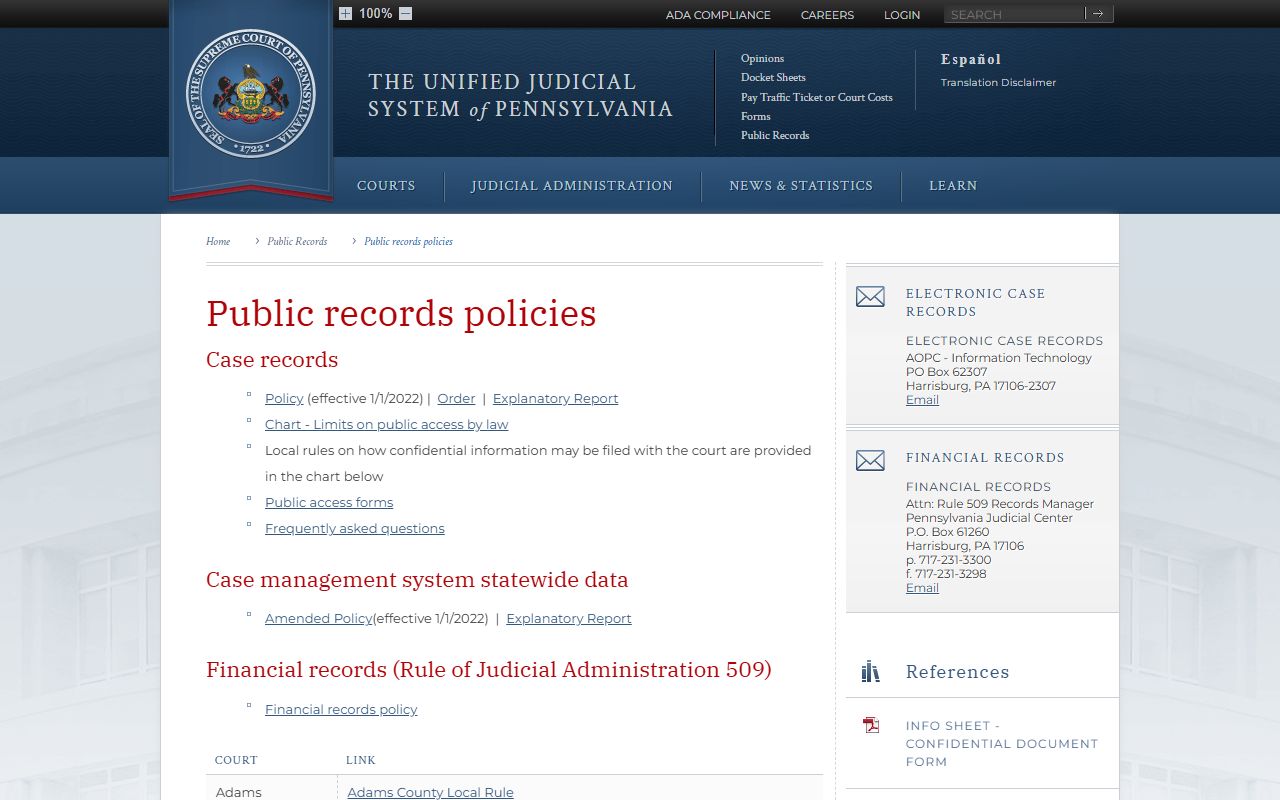
The policy source explains why a visible docket may still omit private identifiers, sealed filings, or confidential case details.
Allegheny County Court Records In Person
In-person access is still important in Allegheny County because online docket sheets do not always include scanned pleadings or certified copies. Civil and family records are handled at the City-County Building. Criminal files for the current year plus four prior years are in Room 220 of the Allegheny County Courthouse, and older criminal files can be ordered from storage. Computer terminals are available for criminal research, but the county warns that case-related criminal information is not discussed by phone.
Department of Court Records Civil/Family Division
414 Grant Street, First Floor
Pittsburgh, PA 15219-2469
412-350-5729
Monday-Friday 8:30 a.m.-4:30 p.m.
Civil and Family Court Records
DCR Criminal Division
Allegheny County Courthouse, Room 220
436 Grant Street, Pittsburgh, PA 15219
412-350-5320
Current year plus four prior years on site; older files ordered from storage.
Criminal Records
For lower-court records, the Magisterial District Court directory identifies the local office by municipality, judge, district number, address, phone, and office hours. Pittsburgh Municipal Court handles city lower-court matters, including arraignment court functions.